

Last year, a friend introduced me to someone at a gathering.
She said, "This is Grazelle — she's a physical therapist and she's also into lifestyle medicine."
The woman smiled politely and said, "Oh, that's so cool. I have a friend who does holistic healing too — crystals, essential oils, that sort of thing. Is it like that?"
I smiled back. "Not exactly."
A month ago, one of my newsletter readers sent me a thoughtful question: "What is lifestyle medicine — is that a course?"
And then a patient, mid-session, asked me point blank: "So you're one of those people who thinks medication is bad?"
Three different people. Three different assumptions. All wrong.
But I don't blame them.
If smart, well-meaning people keep getting this wrong, the problem isn't them. I just haven't explained it clearly enough.
So let me fix that.

My badge from lifestylemedicine.org
Misconception #1: "Lifestyle medicine is alternative medicine"
Lifestyle medicine is not alternative medicine. Not even close.
Alternative medicine uses treatments that lack scientific evidence — and sometimes replaces proven medical care entirely.
Lifestyle medicine does the opposite.
It's built on the same scientific standards, the same peer-reviewed research, and the same clinical rigor as any other medical specialty.
The difference is its focus: using lifestyle interventions — nutrition, movement, sleep, stress management, social connection, and avoiding harmful substances — as the primary approach for preventing, treating, and in some cases reversing chronic disease.
The evidence behind it isn't fringe. It's published in major medical journals.
The Diabetes Prevention Program — one of the largest clinical trials ever conducted — found that lifestyle changes reduced the risk of developing type 2 diabetes by 58%. The medication they tested alongside it? 31%. Lifestyle changes outperformed the drug.
Mediterranean diet research has shown significant reductions in cardiovascular risk, metabolic syndrome, and systemic inflammation — through dietary patterns alone.
A plant-based lifestyle medicine program implemented in a safety-net hospital — a setting with some of the most barriers to change — showed measurable improvements in nutrition, physical activity, and sleep quality within six months.
These aren't wellness blog claims. These are controlled studies.
Lifestyle medicine doesn't reject science. It is science.
Misconception #2: "Lifestyle medicine is a course"
I appreciated this question because it was honest.
And I get why someone might assume that — there are a lot of weekend certifications floating around the wellness space. A two-day seminar, a downloadable PDF, a badge for your Instagram bio.
This is not that.
Lifestyle medicine is a board-certified medical specialty.
Here's what it took for me to earn my credential:
Because I hold a clinical doctorate — a Doctor of Physical Therapy — I was eligible for the highest tier of certification available to non-physicians.
Before I could even sit for the board exam, I had to complete 50 hours of continuing medical education: 30 hours of didactic coursework and 20 hours at a live conference.
Then came the exam itself. Four hours. Proctored. At a Prometric testing center — the same kind of facility where physicians, lawyers, and engineers take their board exams.
Sitting in that testing center brought me right back to my physical therapy licensure exams — both in the Philippines and in the United States.
Same rigor. Same weight. Same "I studied for months for this" energy.
My credential is Diplomate of the American College of Lifestyle Medicine — DipACLM. It's maintained through ongoing education: annual research reviews and 30 hours of lifestyle medicine-specific CME every five years.
So when I share guidance in this newsletter, it comes from that foundation — not from social media trends, not from personal opinion, and not from a weekend webinar.
Misconception #3: "Lifestyle medicine is anti-conventional medicine"
This one I take personally. Because I owe my life to conventional medicine.
In 2010, I was diagnosed with metastatic thyroid cancer. I was 18. The cancer spread to my lungs. Over the next 12 years, I went through surgery, radioactive iodine treatments, and ongoing medication.
Conventional medicine — my surgeon, my endocrinologists, my nuclear med specialist, my cancer specialist — kept me alive. I'm deeply grateful for every one of them.
In 2022, I started implementing lifestyle medicine principles alongside my medical care.
Not instead of it. But alongside it.
I shifted to whole food, plant-based nutrition. I added consistent movement — kickboxing became my thing. I prioritized sleep and stress management.
And I told my doctors. I was the one who opened up and initiated that conversation because they needed to know.
My endocrinologist and my thyroid cancer specialist both supported the changes. They added vitamin B12 and iron checks to my regular labs to make sure my nutrition was on track. We were a team.
Within a year, my cancer went into complete remission. My cancer specialist discharged me from care.
Conventional medicine was my lifeline — it's how my healthcare team helped me survive. Lifestyle medicine was my power play — it's how I helped myself thrive.
These two things are not in conflict. They never were.
I want to be clear about something: some conditions absolutely require medication, surgery, or other conventional interventions.
Lifestyle medicine doesn't replace those. It strengthens the foundation so the rest of your medical care works better.
Always work with your healthcare team.

So What IS Lifestyle Medicine?
Lifestyle medicine is a medical specialty that uses evidence-based lifestyle interventions as the primary method for preventing, treating, and in some cases reversing chronic disease.
Instead of defaulting to medications or procedures as the first line of treatment, it addresses the root causes — the daily habits that drive the majority of chronic illness.
It's built on six pillars:
Nutrition — Whole food, plant-predominant eating
Physical Activity — Regular movement (at least 150 minutes per week of moderate activity)
Restorative Sleep — 7 to 9 hours of quality sleep per night
Stress Management — Evidence-based practices that regulate the nervous system
Avoiding Harmful Substances — No smoking, minimal or no alcohol
Connectedness — Meaningful relationships and having a sense of purpose and meaning
None of these are controversial. No credible researcher is debating whether sleep, nutrition, and movement matter.
And yet — only 6% of Americans meet basic lifestyle guidelines. That means doing the fundamentals alone puts you ahead of 94% of the population.
The evidence doesn't just show that these things help.
In key studies, lifestyle interventions outperform medication.
Intensive lifestyle programs have shown reversal of coronary artery disease and type 2 diabetes remission — not just slowing progression, but actually reversing it.
The Gap That Nobody Talks About
If the science is this clear, why isn't everyone doing it?
Because knowing what to do and actually doing it — consistently, sustainably, through the chaos of real life — are completely different skills.
Most people know they should eat better, move more, sleep more, stress less.
Their doctor tells them. They read about it. They nod.
And then they go home and nothing changes. Or they change for three weeks, then stop.
That gap — between knowing and doing — is exactly why I built everything I teach around two things: Proof and Practice.
Proof:
The evidence-based fundamentals of lifestyle medicine.
The science that actually works.
Not fads, not biohacks, not supplements marketed as miracles.
The six pillars I just described are the foundation.
Practice:
The real-life implementation for people with demanding careers, full lives, and zero interest in becoming a full-time wellness project.
How to build health habits that hold up when things get messy.
How to adapt without quitting.
How to stop starting over every Monday and actually sustain the basics — imperfectly, consistently, for years.
That's what I do here. I teach you what the science says AND how to implement it when life won't cooperate.
Because the fundamentals only work if you can actually sustain them.
One Thing
If you've read this far, you now know what lifestyle medicine is. You've seen the evidence. You know the six pillars. The fundamentals aren't a mystery.
The gap isn't knowledge. It's implementation.
So instead of bookmarking this newsletter and moving on to the next article, do one thing from it today.
Pick one pillar.
Take one action.
Go for a 15-minute walk.
Put your phone in another room before bed.
Add one serving of vegetables to your next meal.
One thing. That's the practice.
And if you want to explore lifestyle medicine further, the American College of Lifestyle Medicine has a wealth of resources at lifestylemedicine.org.
What's one small thing you could do today?
Hit reply and tell me. I read every response.
With gratitude,
Grazelle 🌱
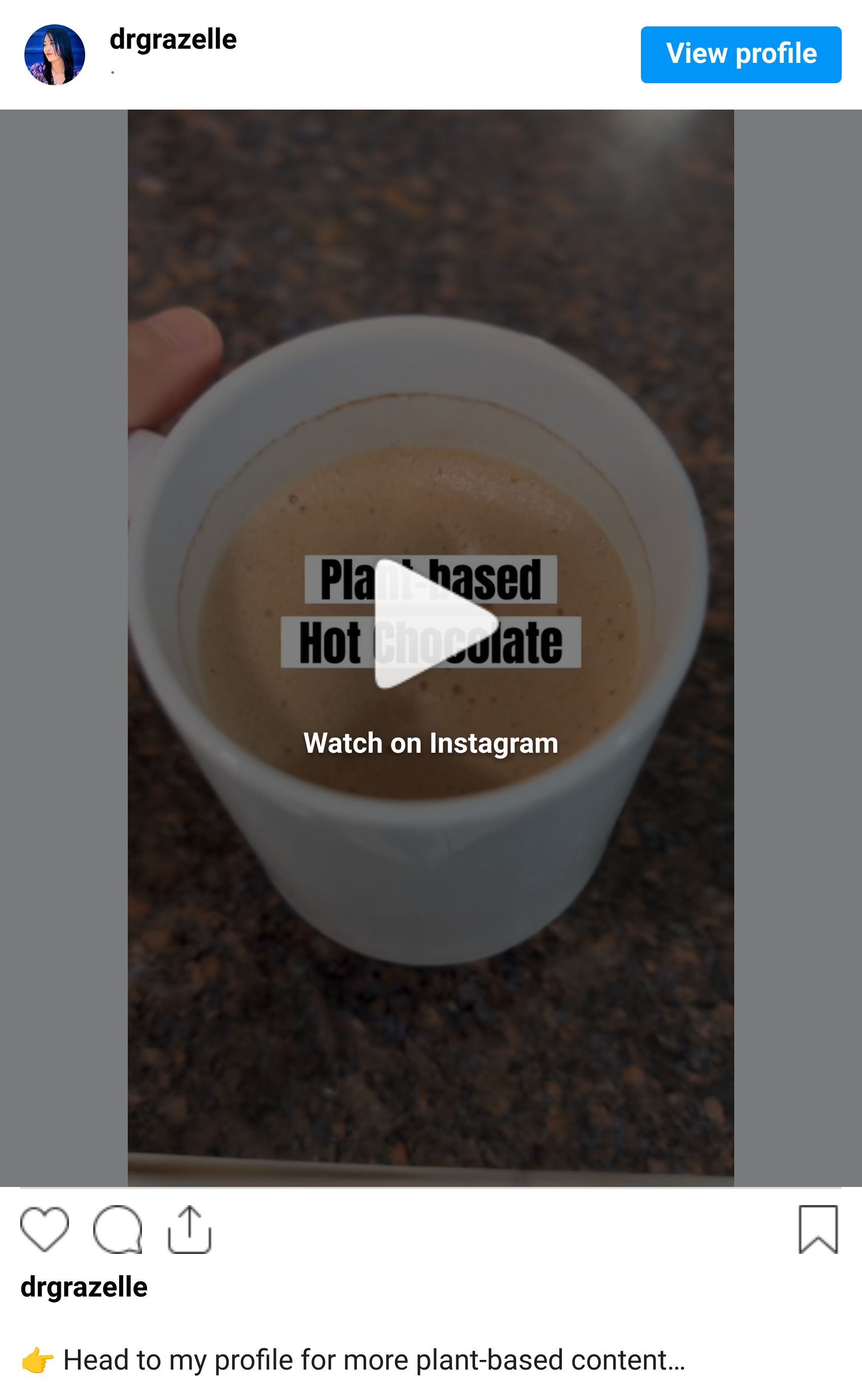
P.S. On a lighter note — I've been making this hot cocoa recipe that's become my evening ritual. Simple, warm, and perfect for this season. ☕
Here's the video if you want to try it:
Whenever you’re ready, here are some other (free) resources you can check out:
Join the free Health Habit Reset 7-Day Challenge for evidence-based strategies that fit your busy schedule.
Want to start eating plant-based? Grab this free guide to simplify your transition to a whole food plant-rich lifestyle.